
Jason Morrow · Salt Lake City, Utah
The maker
He does not make a pen twice.
Jason Morrow · Founder and sole maker
Jason Morrow makes every Morrow pen himself, start to finish, at a single bench. There are no assistants at the lathe and no second shift. When a pen leaves the studio it has passed through one pair of hands, and those hands have signed it.
A refusal to settle
Jason came to pens the way most obsessives come to anything: by being unable to find the thing he wanted to buy. Every pen he tried was almost right. The balance sat a few millimetres too far back. The nib needed a week of work before it wrote cleanly. The cap threads were fine, and fine was the problem.
So he bought a lathe, ruined a great deal of ebonite, and kept going until a pen came off the bench that he could not improve. That is still the only standard in the studio. A pen is finished when he has run out of ways to make it better, not when the hours are up.
Unique by design, not by accident
Most makers who work alone eventually settle into a house shape and let the material provide the variety. Jason does the opposite. The material is chosen for the hand that will hold it, and the shape follows: a longer section for a high grip, a heavier barrel for someone who presses, a lighter one for someone who writes for hours.
The result is that no two Morrow pens are the same, and it is not because he cannot repeat himself. It is because he will not. A pen that could belong to anyone belongs to no one.
Where the standard lives
The standard is easy to describe and hard to meet. Threads should seat with one soft turn and never cross. A cap should post without wobble or not post at all. The nib should write the first time, wet and silent, with no pressure. The finish should look better under a loupe than it does from across the room.
None of that is visible in a photograph. All of it is obvious in the hand. That is where Jason's work is meant to be judged, and it is the only place he judges it.
Lineage
Mr. Morrow trained under Bob.
Bob lives two doors down. He is also the only living pen maker to hold the Ninth Cut, the highest distinction in the craft, conferred nine times in a century and only on a maker whose nibs the judges could not fault by eye, by ear, or on paper. He turned his first barrel more than fifty years ago and has never let a pen leave his bench that he could still improve.
For six years Jason crossed the lawn on Saturday mornings to be told, precisely and without ceremony, what was wrong with his. The morning Bob picked up a pen, wrote a line, and said nothing at all, Morrow Pens began.
“If I could make it better and I chose not to, it isn't finished. It's just late.”
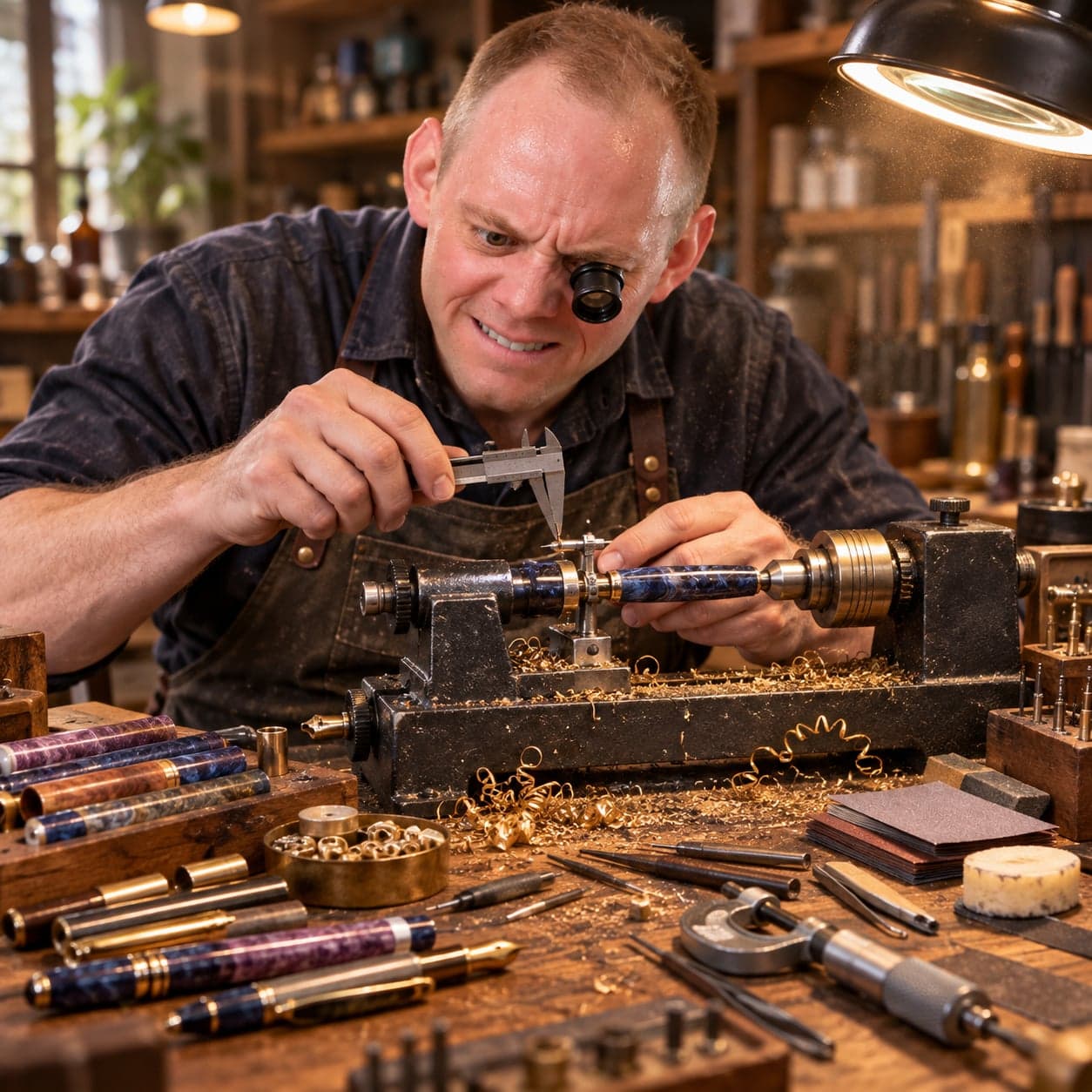
At the bench
One lathe. One pair of hands.
Every dimension is checked against the hand, not a drawing. The barrel on the lathe is measured, cut, and measured again until there is nothing left to take off.
What the studio holds to
Four rules, no exceptions.
- I
One at a time
No batching. Each pen is turned, fitted, and tuned as its own project, from the first cut to the signature.
- II
Weight before beauty
Balance is decided first and never traded away for a shape. A pen that looks right and sits wrong is a paperweight.
- III
Tuned, not adjusted
Every nib is written with on real paper before it ships. It leaves the bench doing exactly what was asked of it.
- IV
Never sold
No Morrow pen has a price. Each is placed with a person or cause whose work improves the lives of others, and it comes home to the maker whenever it needs care.
Made by one person, for one person.
Morrow pens are never sold. If you believe a pen belongs in your hands, or in the hands of someone whose work deserves it, the placement process begins with a conversation.